October 1 is World Vexillology Day, or VexiDay, a chance to take a closer look at flags and the stories they tell. Whether you’re a longtime flag enthusiast or encountering the word “vexillology” for the first time, there’s plenty to explore, from familiar symbols to the details you may never have noticed.
Inspired to create a flag that tells your own story? Share your ideas with our team at Accent Banner, and we’ll help you explore the possibilities and provide a free quote.
What is Vexillology?
Vexillology is the study of flags: their history, design, symbolism, and use. It explores not just what a flag looks like, but what it means to the people who display it. The word combines the Latin "vexillum", a kind of flag carried by Roman cavalry, with the Greek suffix "logia" meaning “the study of.” The term was coined by Massachusetts' own Whitney Smith, who went on to found multiple vexillological associations.
Vexillology Associations
Around the world, vexillological associations bring together people who are interested in the history, design, and meaning of flags. For members, a flag is more than a pattern of colors and shapes. It can tell a story about a place, a community, or a shared tradition. These groups offer a way to exchange knowledge, explore how flags have changed over time, and look more closely at the symbols we often see every day. One example is the International Federation of Vexillological Associations (FIAV), which is the international umbrella organization for vexillologists. FIAV links several vexillogical associations/institutions, rather than individuals, which better allows these associations to organize themselves to their liking, as opposed to having one single organization speaking for flag-fans worldwide.
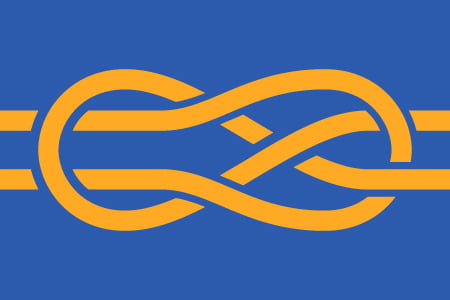
The flag of the International Federation of Vexillological Associations
The Flag Research Center, established in 1962, is among many other associations under FIAV's membership. The FRC was founded by Whitney Smith, and he worked at its Winchester offices from its founding until his death in 2016. When asked why people should take the study of flags more seriously, he responded:

"People kill for flags. People die for flags. It is incumbent on us to try to understand how a piece of cloth can incarnate that power.”
Mr. Smith's influence on the study of flags cannot be overstated. His childhood love of flags developed into a collection of over a quarter-million documents and tens of thousands of books, pamphlets, engravings, electronic files, and flag-related artifacts. He is responsible for the creation of several associations that allowed for the growth of flag scholarship. He authored 27 books on the subject over the course of his life. He designed the national flag of Guyana himself at age 20.
In his Vexillologist’s Credo, he says, "Vexillology is like a great banner set before the world.
Fashioned by many hands, it manifests unity; torn by violent gales, it holds entire; variegated in its form, it partakes of beauty; bound to an unmoving staff, it floats free."
Vexillology Terms
Vexillology studies flags and the stories behind them; vexillography focuses on designing them. Both have their own vocabulary, but you don't need to learn it all at once. Here are a few useful terms to get started.
Badge: A coat of arms or simple heraldic symbol.
Canton: Any quarter of a flag, but commonly means the upper left quarter, such as the starry portion of the US flag.
Charge: Generically, any emblem, object, or design placed upon the field of a flag or shield
Emblem: A device often used as a charge on a flag. Think of the maple leaf on the Canadian flag.
Field: The background of a flag. The flag of Switzerland has a red field.
Fimbriation: A narrow edging or border, generally in white or gold, on a flag to separate two other colors. This appears in the white and gold lines on the flag of South Africa.
Fly/Fly-end/Fly-edge: The edge or section of a flag, which lies opposite to (or furthest from) the flagpole, mast, or staff
Heading/Header: A piece of heavy material, usually canvas or double-ply bunting, along the hoist edge of a flag, into which a rope is sewn as the hoistline, or into which grommets are inserted to facilitate the hoisting of a flag
Hoist: The edge or section of a flag, which lies next to the flagpole, mast, or staff.
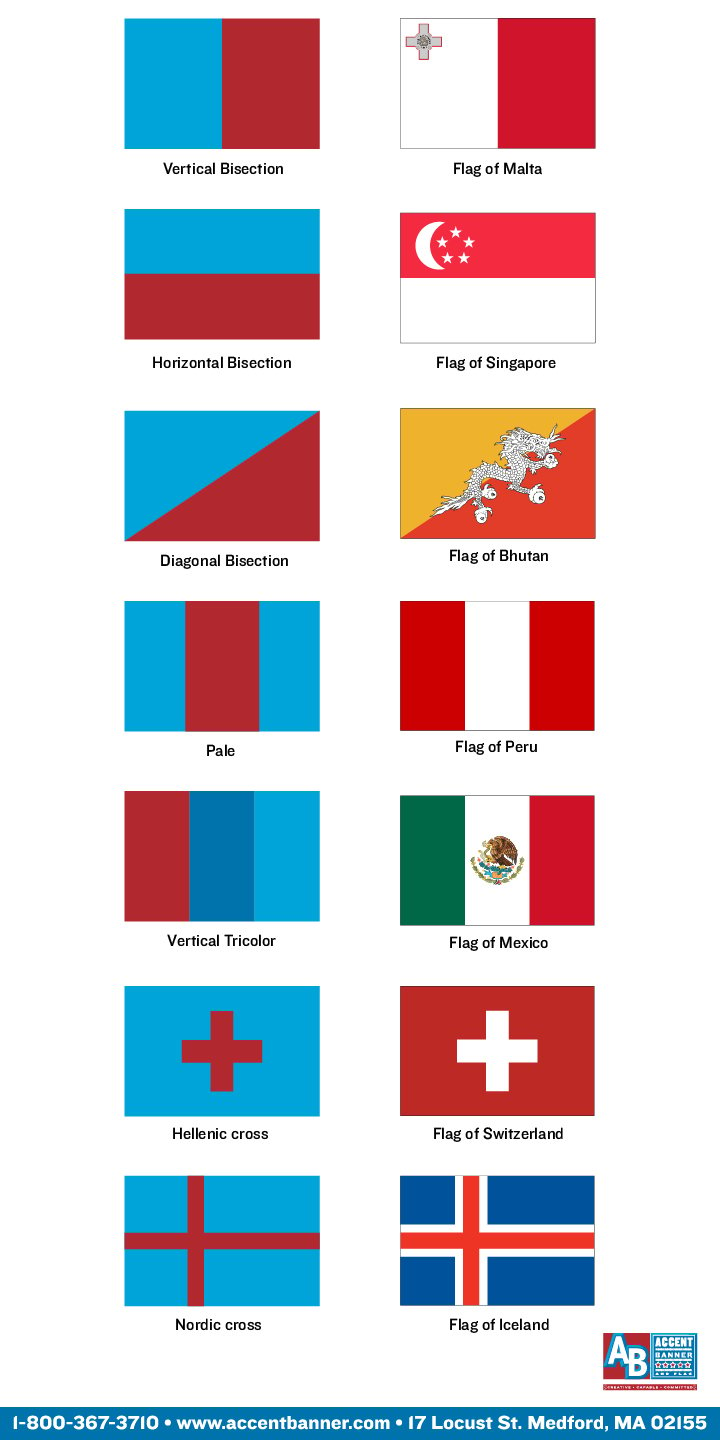
Vexillographical Patterns
Many flag designs draw on the visual language of traditional European heraldry, which is why some patterns and design elements have their own names.